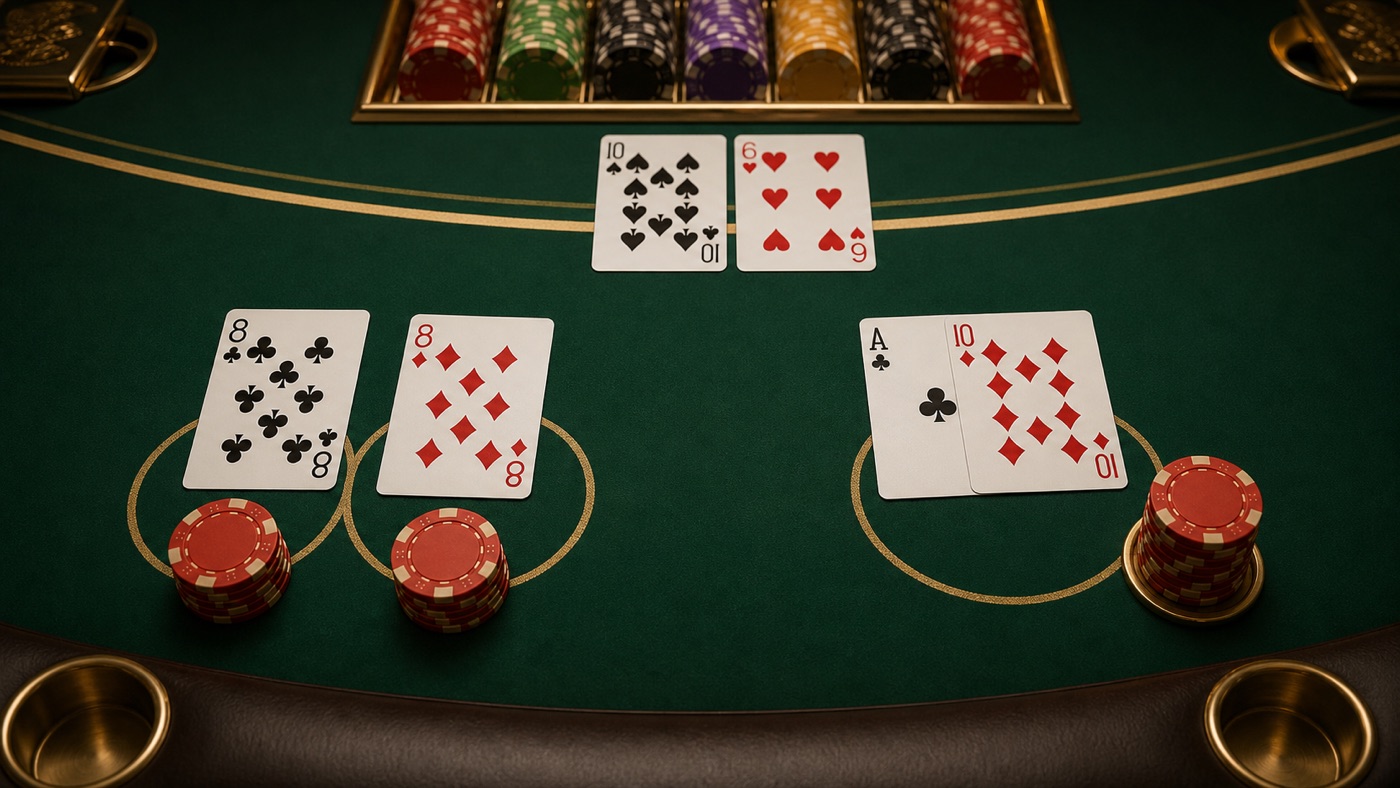
What does double down mean?
To double down, you increase your original bet, usually by the same amount, and receive one final card. After that card, your hand automatically stands. The move is powerful because it lets you add money when your hand has a statistical advantage.
The risk is also obvious: you only get one card. If the card is bad, you cannot draw again. That is why doubling works best when your starting total is strong and the dealer's upcard is weak.
Best common double down spots
| Your hand | Typical double down idea |
|---|---|
| Hard 11 | Often double against most dealer upcards, because many cards make 19-21. |
| Hard 10 | Often double against dealer 2-9, but be careful against 10 or Ace. |
| Hard 9 | Often double against weaker dealer cards such as 3-6. |
| Soft 16-18 | May double against weak dealer upcards, depending on the exact hand and rules. |
Why hard 11 is so strong
Hard 11 cannot bust with one card, and a 10-value card creates 21. Since 10-value cards are the most common card group in blackjack, hard 11 is one of the clearest double down opportunities. The dealer upcard still matters, but this is the hand most beginners should recognize first.
Do not double just because you feel lucky
Double down is not a comeback button. It should be tied to hand strength and dealer weakness. Doubling hard 12, 13, 14, 15, or 16 is usually poor because too many single cards leave you weak or busted. Doubling a strong made hand such as 19 or 20 is also usually unnecessary.
Soft doubles are where players improve
Soft hands confuse many beginners. A hand like Ace-6 is soft 17. Against a weak dealer card, doubling can be better than simply hitting because the Ace protects you from busting. These soft doubles are one reason a strategy chart matters.