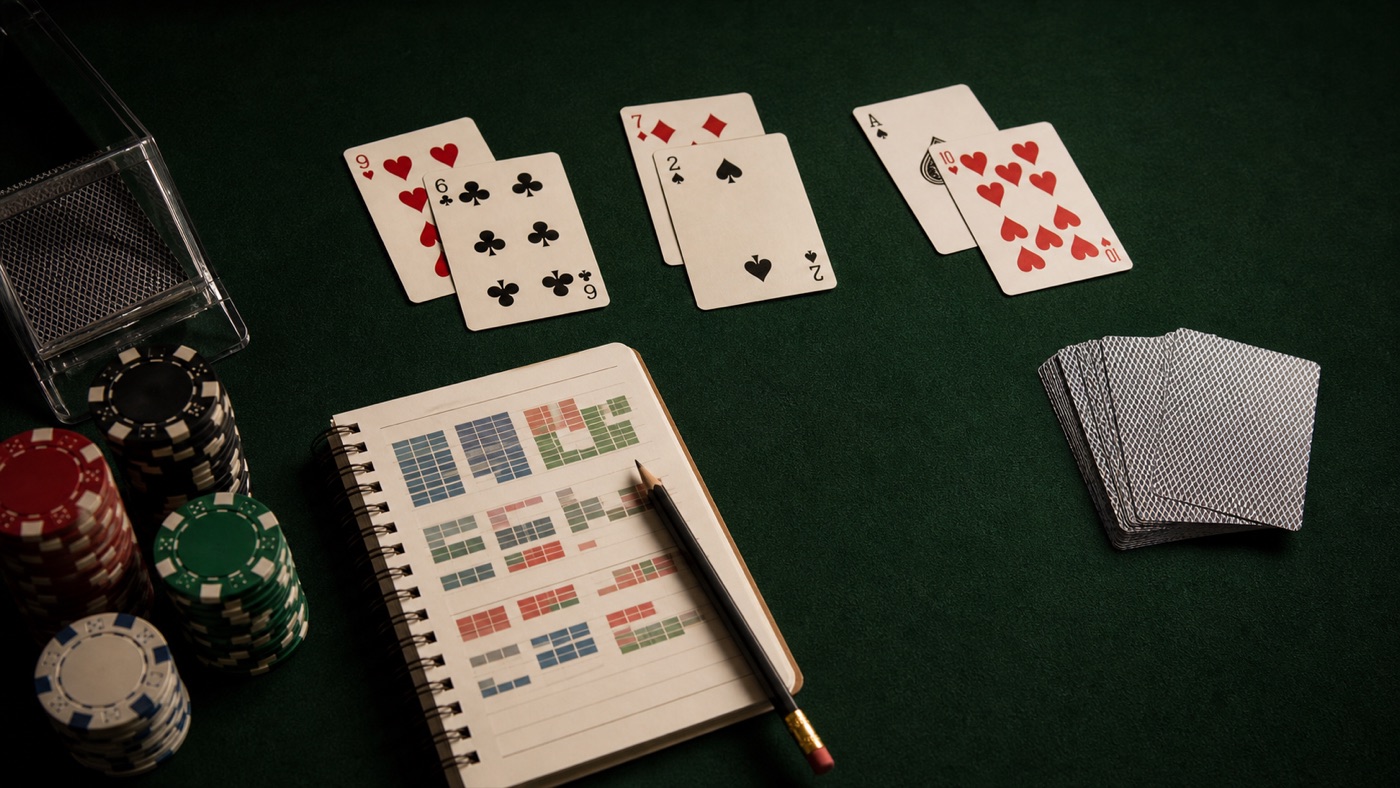
What card counting is
Card counting tracks groups of cards that have already been played. When many low cards have left the deck, more high cards may remain. That can help the player because high cards increase the chance of blackjack, strong totals, and dealer busts in some situations.
Counting does not tell you the next card. It gives a rough estimate of deck composition over time.
The basic Hi-Lo count
Hi-Lo is the most common beginner system because each card group has a simple value.
| Cards | Count value |
|---|---|
| 2, 3, 4, 5, 6 | +1 |
| 7, 8, 9 | 0 |
| 10, Jack, Queen, King, Ace | -1 |
Running count and true count
The running count is the total you keep as cards appear. If you see 5, King, 4, 8, Ace, your count changes +1, -1, +1, 0, -1, ending at 0.
In multi-deck games, players often convert running count to true count by dividing by the estimated decks remaining. A running count of +6 means something different with one deck left than with six decks left.
Why counting is not a beginner shortcut
Counting only matters after you already know basic strategy. If you misplay hit, stand, split, and double down decisions, counting will not save the game. It also requires attention, speed, accuracy, and rule awareness.
Online blackjack often uses frequent shuffling or random number generation, so traditional card counting may not apply. Live dealer games can also use procedures that reduce counting value.
How to practice card counting
- Learn basic strategy first.
- Count through one deck slowly using Hi-Lo values.
- Try to finish a deck at zero.
- Add speed only after accuracy is consistent.
- Study true count only after the running count feels natural.